Floyd Is Back in the Kitchen: Bringing a 1986 C64 Game to the Browser with Claude
Note: This post mentions code files and directories from the project. The repository is not public. If you want access, mail me at oglimmer@gmail.com.
▶ Play it: https://the-big-deal.oglimmer.com
I was twelve. The Commodore 64 was the center of my world, and one game on it stuck with me for the rest of my life: The Big Deal – Floyd in der Küche, a German game from 1986 by Radarsoft, published by Ariolasoft.
Floyd is a kitchen robot in a small diner. Customers sit down and order. You get Floyd to walk, ride his lift, take things out of the cupboard and the fridge, wash, cut, fry, bake, and serve, all while the clock runs and the customers get more and more impatient. Nobody else made a game like it, and I never forgot it.
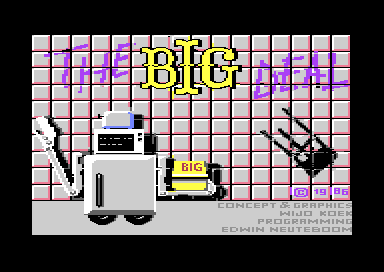
This post is about how that game came back to life in a web browser over three days in September 2026. First as the original in an emulator, then as a full JavaScript rewrite, and finally with a completely new look. I did it together with Claude, Anthropic's AI coding agent. I brought the nostalgia and watched. Claude did the work.
All I had was a disk image
There is no source code for The Big Deal. As far as I know, it was never released. All I had was
BIGDEA-D.D64: a 174 KB image of a 5¼" floppy disk.
A D64 file is a byte-for-byte copy of a C64 floppy. Inside it there is a packed program. When you unpack it, you get about 60 KB of code, custom graphics, a SID tune and German text in a custom encoding. No names, no comments, no symbols. Only bytes.
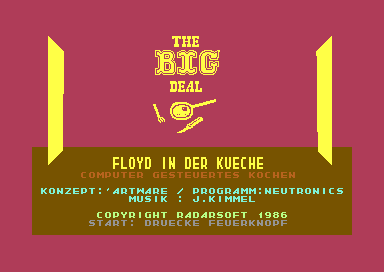
Step 1: The original, in an emulator
The first question was simple: what is the fastest way to play this in a browser at all?
The answer was an emulator. EmulatorJS runs VICE, the best-known C64 emulator, compiled to WebAssembly. You give it a disk image and it boots a virtual C64 in the page.
There was one problem. The disk started with an intro that wanted a press of the space bar, and EmulatorJS maps the space bar to the joystick. So the game never started. Claude's fix was to build a new disk: a 116-byte boot loader plus the already-unpacked game, which jumps straight to the game's entry point. No intro, straight to the title picture.
That is in webapp/, and it took hours, not weeks. I could play The Big Deal in a browser tab
again. Real graphics, real SID music, real rules.
But it was a black box. I could not change anything: not the controls, not the look, not the difficulty. And the controls were the hard part. The game hides its menus on diagonals: fire + up, fire + down, fire + left, fire + right. That is fine with a joystick in 1986. It is not fine on a laptop keyboard.
So we wrote down the decision (docs/decisions/0001-…) and went one step further.
Step 2: A real rewrite, from the bytes
The goal of step two was the game itself in JavaScript. No emulator, no CPU simulation, just code that I can read and change.
We had three options:
- Play the game a lot, write down the rules, and build a look-alike.
- Translate every 6502 instruction to JavaScript. That gives you an emulator in disguise.
- Find out how the code was made, and decompile it.
Option 3 won, because of one lucky discovery.
The lucky discovery
The Big Deal was not written in hand-made assembly. Most of it was written in BASIC and then compiled by a BASIC compiler. That compiler produced very regular machine code: every statement is a fixed pattern of calls into a small runtime library at the start of memory. Push this number. Pop that one. Compare. Jump.
Regular patterns are what a computer is good at. So Claude wrote a decompiler in Python
(rewrite/tools/decompile.py). It walks through the machine code, keeps track of what the
compiler put on its stack, and writes out JavaScript. The result is src/game_code.js: 165
functions, one per original procedure, about 7,300 lines. The old GOTO statements became a
switch on a label.
The rest was ported by hand:
| Piece | What it does |
|---|---|
src/rt.js |
the compiler's runtime: text, strings, windows, math |
src/ml.js |
the hand-written machine code: raster interrupts, sprites, kitchen scroll, sound, timers |
src/vic.js |
the picture, rebuilt from the same bytes the C64 graphics chip read |
src/sid.js |
the music (with jsSID) and the sound effects (with Web Audio) |
One idea holds it all together. Everything lives in one 64 KB memory image, at the original C64 addresses. The ported code writes the same bytes that the 6502 wrote. So we can compare the rewrite with the emulator byte by byte and pixel by pixel.
And we did. The first day ended with the rewrite drawing the kitchen, and 62,905 of 64,000 pixels matched a VICE screenshot. The rest was animation phase.
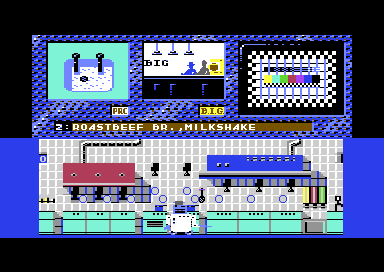
Bugs, found by comparing
Comparing against the original found five bugs on the first day. My favourite: in the
decompiler, a CASE statement used up its own value after the first test. So in a list like
"is it left? is it right? is it up?", only the first question could ever be true. That is why
only one station in the whole kitchen reacted to the joystick.
Some bugs were not in the game at all, but in the web platform. The music was silent on the first visit to the live site, but fine on my machine. The reason is the browser's autoplay rule: the game asked for its title tune before the first click, and the audio library made its own audio context and never woke it up. On a site you visit often, Chrome is more relaxed, so I never saw it locally.
At the end of the first day, the rewrite was live on my Kubernetes cluster at https://the-big-deal.oglimmer.com.
Step 3: Making the code readable
Now we had a faithful game, but ugly code. The generated code said M[0x817a] where a human
would say DAY. For me this is also a learning project, so I wanted the code to read like prose.
Change nothing, and prove it
The hard rule for this step: the behavior must not change by a single byte. So before any
refactor, Claude built a test for it. tools/headless.mjs runs the game in Node.js, with no
browser, a fixed clock and a seeded random number generator. Two runs with the same input give
the same result. tools/diff_baseline.mjs runs the same session on the current code and on an
older git commit, and compares all 65,536 RAM bytes and all 64,000 pixels.
With that safety net, ml.js and rt.js got names for every C64 address, JSDoc comments, and
long functions split into named steps. The test said: identical.
Watching the game to learn what it means
How do you find out what byte $817A is for? You can read 60 KB of compiled BASIC. Or you can
watch.
Because the headless runs are reproducible, any difference between two runs has exactly one
cause. tools/hunt_vars.mjs uses that. It runs the game once with the joystick idle and once
with "left" pressed, and prints the bytes that are different. It logs every character the game
prints. It walks Floyd across the whole kitchen and presses a button at each stop, so every
appliance tells you its name.
Every name we added was confirmed twice: once by watching, once in the code. After that, the
decompiled listing said DAY instead of V817A.
A bug from 1986
Then we wrote down the rules of the game in plain words (rewrite/notes/gameplay.md): five days
on a clock that starts at 08:50, five seats, 23 dishes, how cooking works, how points are given.
Every sentence says where it comes from: measured or read in the code.
One rule did not make sense. Some ingredients must be seasoned (gewürzt). But nothing in the whole program ever set the "seasoned" bit.
So Claude did an experiment. For each dish, it built the best plate the kitchen can actually make, and asked the game's own judging routine to rate it. Result: only 9 of 23 dishes could ever be accepted. Every rejection was "wrong preparation" on an ingredient that needs seasoning.
Then it changed one single byte: a mask at address $BB1C, from $C0 to $C1. Now: 23 of 23,
every ingredient with full points.
That is a bug in the original game from 1986. With that one wrong byte, more than half of the menu could never be served. If some dishes never worked for you back then: it was not you. The rewrite fixes this byte. It is the only deliberate change to the original rules.
Things I never knew
Watching the game closely showed me things I never noticed as a kid:
- An angry customer who leaves throws something at Floyd on the way out: a mop, a bar stool or a bottle, chosen at random. If it hits him, he needs a repair.
- The far left end of the kitchen is not a door. It is a box dispenser.
- The box Floyd carries has two positions. In one, an item from the fridge drops straight into the box. In the other, Floyd keeps it in his hand. The game never tells you this.
Step 4: A new look
With the game state named and understood, we could finally build what I wanted from the start: the same game, with a new face.
The design has one seam. src/state.js reads the 64 KB memory, never writes it, and returns a
plain object: the time, the scores, where Floyd is, what is in the box, what each customer
ordered and how long they have waited. Everything new is built on top of that object. The
original game logic underneath stays byte-exact.
On top of that seam:
- One key per action.
Euses the appliance in front of Floyd,Mopens the menu,Fserves, the arrow keys walk and ride the lift. Number keys pick a menu row directly. Under the hood, a number key is a small macro that holds the joystick until the game's own cursor reaches the row, and then presses fire. - Menus as real HTML. The menu text is not rebuilt. It comes from a mirror of the C64 text screen, so it is exactly what the game just printed. But now you can click it, select it and zoom it.
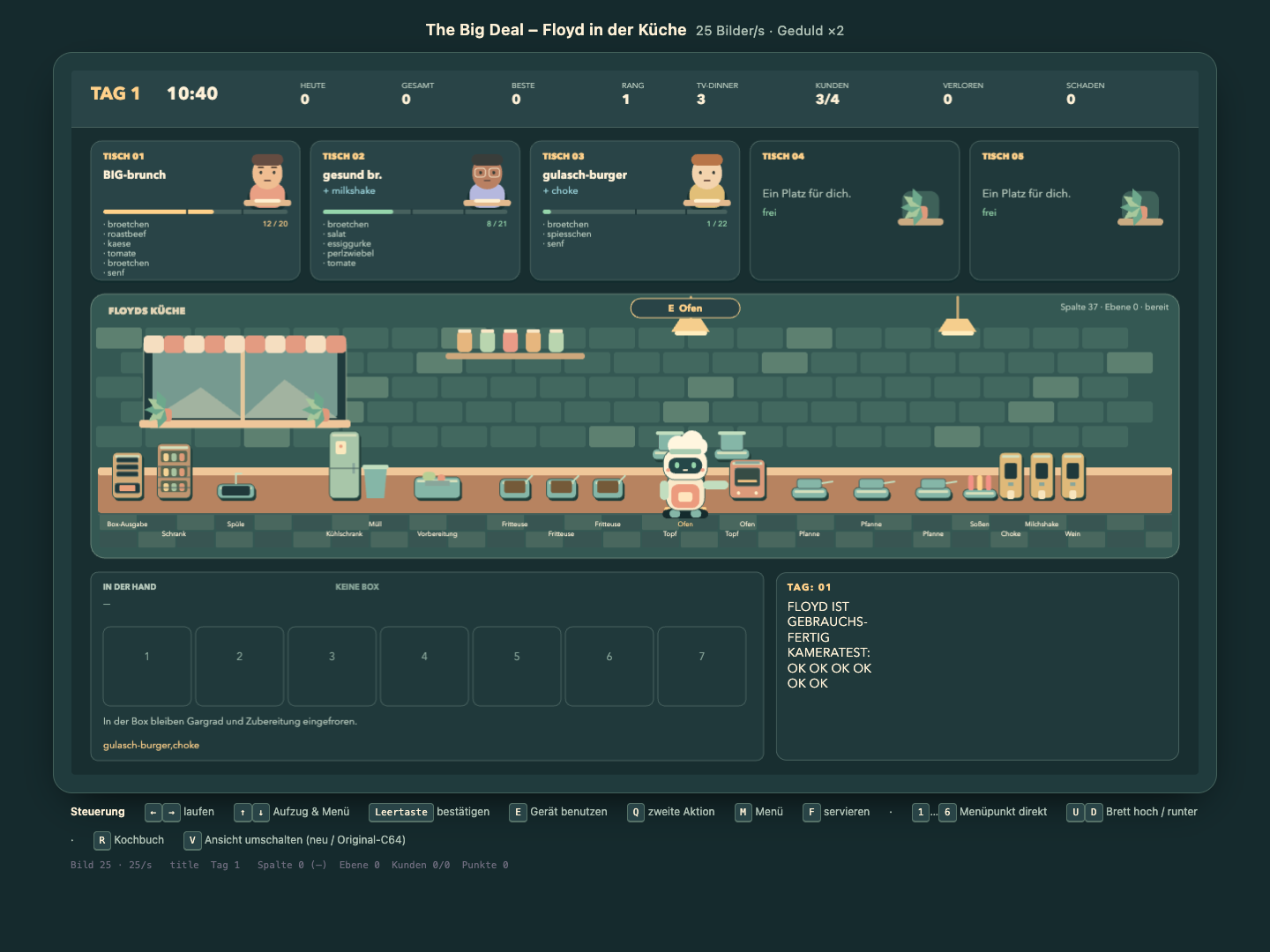
- The whole kitchen at once. The original scrolls a 40-column window over the kitchen. The new view shows all of it.
- The hidden numbers. The game always knew how cooked each item was, which preparation step was missing, and how long each customer had waited. Now you can see it.
- A recipe book. Press
Rand a cookbook opens next to the kitchen, with every dish, where each ingredient is and what to do with it. The data is extracted from the game image. - Double patience. In the original, a customer waits about two and a quarter minutes per
plate. With a keyboard that is not much fun. The page gives customers twice as long.
?geduld=1gives you the 1986 timing.
And it got faster. The new page does not draw the C64 picture at all. That step was the most
expensive thing in each frame: 186 µs per frame with the C64 picture, 2 µs without. Press V
and the original picture comes back, for comparison.
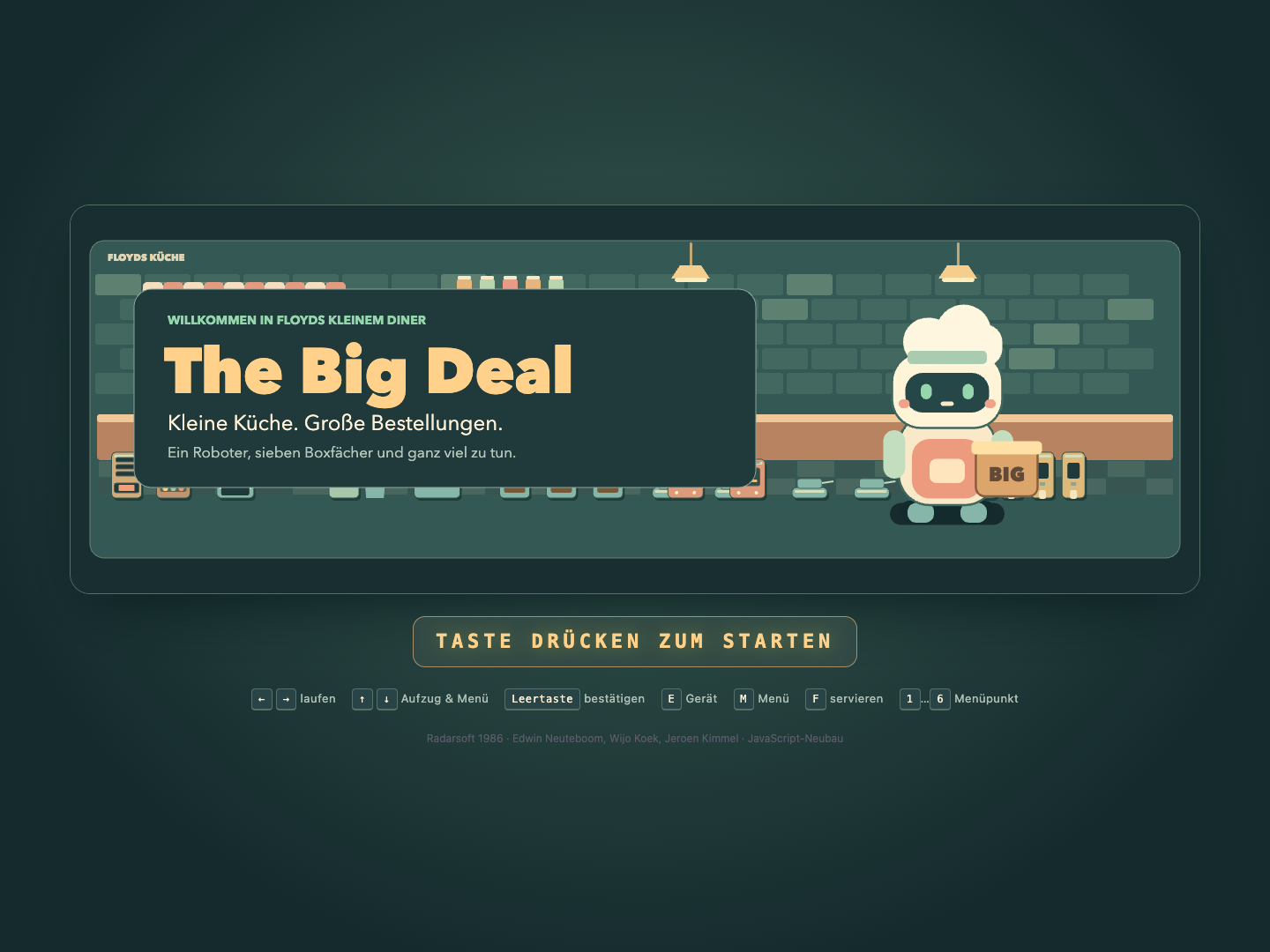
Last, the artwork. The first new view was functional, but plain. So the final step was a cozy diner: mint appliances, peach accents, a tiled wall, a wooden counter, plants, pendant lights, five illustrated customers, and Floyd as a small robot chef. It is all drawn as vector art on a canvas: no image files, no external fonts, no extra libraries.
Working with Claude
What surprised me most: the big transformation just worked. From disk image to emulator, and from bytes to a JavaScript rewrite. Smooth, easy, straight out of the box.
The details are where the problems are. There are still tons of small issues and glitches.
My part? Mostly observing. Claude did the work, and I watched. And watching it work was the fun part. Nothing about it was annoying. It was pure fun to watch Claude work.
Would I do a project like this again? Yes. AI is the only way, at least for me ;)
The numbers
| Time | 3 days, 8 to 10 September 2026 |
| Commits | 35 |
| Input | one 174 KB disk image |
| Generated game code | 165 procedures, about 7,300 lines of JavaScript |
| Hand-written JavaScript | about 4,300 lines |
| Bugs in the 1986 original found | 1 (one byte, 14 dishes) |
| Pixels matching the original on day one | 62,905 of 64,000 |
Play it
https://the-big-deal.oglimmer.com
Press a key, press space, and help Floyd get through his day.
All credit for the game goes to the people who made it in 1986: Edwin Neuteboom (code), Wijo Koek (graphics) and Jeroen Kimmel (music). Thank you for a game that a twelve-year-old never forgot.